

In the modern world, the only thing that remains constant is uncertainty. Be it economic cycles, market fluctuation, changing jobs, rising costs, or events happening around the globe, these unexpected events can knock even the best-laid plans off course. The question isn't whether problems will arise, but how prepared one would be to tackle them.
Scenario planning is a strategic tool that can help individuals, families, and businesses consider the different ranges of plausible futures, weigh possible effects, and work out implementable answers to such scenarios. In addition, if one adds what if planning, analysis of risk scenarios, creation of a robust financial strategy, and elaboration of a protection plan, future preparation can be enhanced and the likelihood of being caught by surprise reduced.
This is your step-by-step guide to master the use of scenario planning and building resilience in personal and professional life
The first step in scenario planning is to clarify what one is preparing for-what is at stake-and set a time horizon. Objectives may include:
Clearly defining the scope ensures your scenario planning will be focused, actionable, and relevant for the circumstances; this sets the boundaries, too, and defines the purpose of your planning.
Next, identify the factors that could substantially impact your future consequence of interest. Examples include:
Once you have listed all the factors that might be relevant, narrow in on the 2-3 most critical uncertainties that are likely to drive the greatest difference, the critical uncertainties represent the starting point for your what if planning and form the basis of your scenarios.
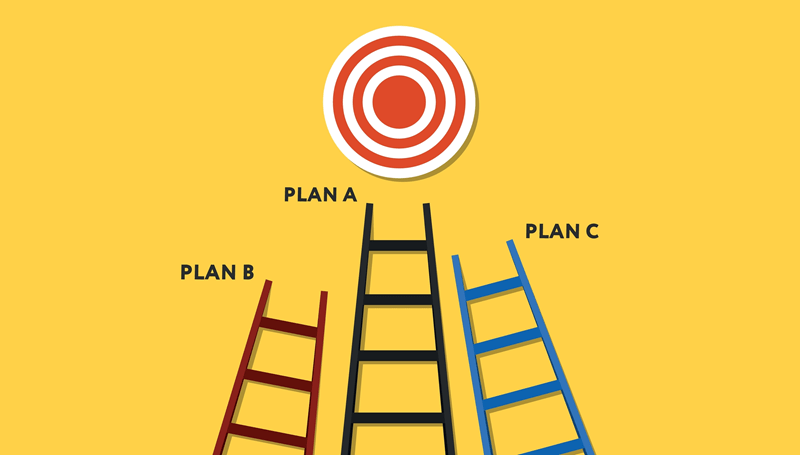
Once the key uncertainties have been identified, develop 3-4 plausible scenarios depicting how the future might evolve. A common set might contain :
Write narratives for each of these scenarios, including qualitative-e.g., emotional or lifestyle impact-and quantitative-financial, operational, or resource outcome-elements. Detailed narratives help make the scenarios more concrete and tangible, and thus actionable in enabling one to prepare for the future.
Now consider the potential consequences of each of these events along the following dimensions.
This will provide a kind of 'stress test' for your vulnerabilities and strengths under the different futures. Understanding the potential impacts informs your financial strategy and enhances your protection plan.
Now, considering the impacts of each situation, come up with a course of action. This could involve:
Design such strategies in advance of challenges so you can be proactive, not reactive. It will then render scenario planning merely a conceptual exercise, turning it into an instrumental tool that protects your long-term goals.
Indicators are measurable signals that show which scenario is beginning to unfold. Examples include:
Establish clear trigger points to begin action, such as if revenues decline by 20 percent or expenses extend beyond your threshold, then take your pre-defined scenario response. A trigger point ensures that your protection plan is well executed, not belatedly, and limits possible negative consequences.
Scenario planning is not a point-in-time activity. The world is changing continuously, and so must your assumptions, metrics, and plans. Go back and revisit your plan on a regular schedule, say every 6-12 months, and refine it each time there are significant life or market changes.
Ongoing evaluation allows you to revise your financial strategy and tweak your protection strategy to keep future preparation on a strong footing to counter the emergent risks and opportunities.
Proactive preparation involves acting prior to events, rather than being reactive when under pressure.
Scenario planning is a potent framework to deal with uncertainty. The definition of objectives, identification of critical uncertainties, building plausible scenarios, assessment of impacts, and development of actionable response strategies create a structured protection plan and a strong financial strategy.
For individuals, families, and businesses alike, scenario planning fosters clarity, confidence, and foresight necessary to surmount a challenge effectively. It turns uncertainty into an anxiety-free opportunity, manageable and strategic. Unpredictable, the future may well be, but thoughtful scenario planning and proactive future preparation will help you to confidently go into whatever is coming next.
While forecasting predicts a single future based on historical trends, scenario planning explores multiple plausible futures. It is a means of asking "what if" questions and prepares you for a set of alternatives rather than depending on a single prediction.
Usually, 3–4 are enough: best-case, baseline, worst-case, and optionally a wildcard scenario. That's enough to make it manageable but still cover the range of possibilities.
Review on a regular basis every 6–12 months. Updates should be done when there are significant changes in your personal situation, immediate business environment, or overall market conditions.
This content was created by AI